Friday, July 10, 2009

Delicious


URLdelicious.com
Commercial?Yes
Type of siteOnline social bookmarking
RegistrationOptional
OwnerYahoo! Inc.Yahoo! Inc.
Created byJoshua Schachter
LaunchedSeptember 2003
Current statusActive


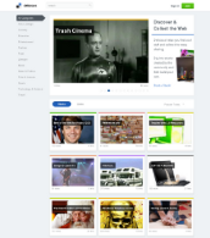
Delicious (formerly del.icio.us, pronounced "delicious") is a social bookmarking web service for storing, sharing, and discovering web bookmarks. The site was founded by Joshua Schachter in 2003 and acquired by Yahoo! in 2005. It has more than five million users and 150 million bookmarked URLs.[1] It is headquartered in Sunnyvale, California.

Site description
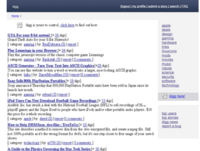
Delicious uses a non-hierarchical classification system in which users can tag each of their bookmarks with freely chosen index terms (generating a kind of folksonomy). A combined view of everyone's bookmarks with a given tag is available; for instance, the URL "http://delicious.com/tag/wiki" displays all of the most recent links tagged "wiki". Its collective nature makes it possible to view bookmarks added by similar-minded users.

Delicious has a "hotlist" on its home page and "popular" and "recent" pages, which help to make the website a conveyor of internet memes and trends.

Delicious is one of the most popular social bookmarking services.[2] Many features have contributed to this, including the website's simple interface, human-readable URL scheme, a novel domain name, a simple REST-like API, and RSS feeds for web syndication.

Use of Delicious is free. The source code of the site is not available, but a user can download his or her own data through the site's API in an XML or JSON format, or export it to a standard Netscape bookmarks format.

All bookmarks posted to Delicious are publicly viewable by default, although users can mark specific bookmarks as private, and imported bookmarks are private by default. The public aspect is emphasized; the site is not focused on storing private ("not shared") bookmark collections.[3] Delicious linkrolls, tagrolls, network badges, RSS feeds, and the site's daily blog posting feature can be used to display bookmarks on weblogs.

History
The precursor to Delicious was Muxway, a link blog that had grown out of a text file that Schachter maintained to keep track of links related to Memepool.[4] In September 2003, Schachter released the first version of Delicious.[5] In March 2005, he left his day job to work on Delicious full-time, and in April 2005 it received approximately $2 million in funding from investors including Union Square Ventures and Amazon.com.[6] Yahoo! acquired Delicious on December 9, 2005.[7] Various guesses suggest it was sold for somewhere between US$15 million and US$30 million.[8][9]

There are several competing social bookmarking services as well as a few open source clones.

Name
The "del.icio.us" domain name was a well-known example of a domain hack, an unconventional combination of letters to form a word or phrase. Del.icio.us and delicio.us now redirect to the new domain, delicious.com.

In an interview, Schachter explained how he chose the name: "I'd registered the domain when .us opened the registry, and a quick test showed me the six letter suffixes that let me generate the most words. In early discussions, a friend referred to finding good links as 'eating cherries' and the metaphor stuck, I guess."[10]

On September 6, 2007, Schachter announced the website's name would change to "Delicious" when the site was redesigned.[11][12] The design went live on July 31, 2008.
The old logo of Delicious.


info:wikipedia.org

digg


TypePrivate
FoundedSan Francisco, California (December 5, 2004)
Founder(s)Kevin Rose
HeadquartersSan Francisco, California, United States
Area servedWorldwide
Key peopleKevin Rose (Founder) Jay Adelson (CEO)Scott Baker(Operations Director) John Moffett (CFO) Daniel Burka (Creative Director)
Employees71
Websitedigg.com


Digg is a social news website made for people to discover and share content from anywhere on the Internet, by submitting links and stories, and voting and commenting on submitted links and stories. Voting stories up and down is the site's cornerstone function, respectively called digging and burying. Many stories get submitted every day, but only the most Dugg stories appear on the front page. Digg's popularity has prompted the creation of other social networking sites with story submission and voting systems.

History and description

Digg started out as an experiment in November 2004 by Kevin Rose, Owen Byrne, Ron Gorodetzky, and Jay Adelson. All except Byrne currently play an active role in the management of the site. "We started working on developing the site back in October 2004," Rose told ZDNet.[6] "We started toying around with the idea a couple of months prior to that, but it was early October when we actually started creating what would become the beta version of Digg. The site launched to the world on December 5, 2004." Rose's friend, David Prager (The Screen Savers, This Week in Tech), originally wanted to call the site "Diggnation", but Rose wanted a simpler name. He chose the name "Digg", because users are able to "dig" stories, out of those submitted, up to the front page. The site was called "Digg" instead of "Dig" because the domain name "dig.com" had been previously registered by the Walt Disney Internet Group. "Diggnation" would eventually be used as the title of Rose and Alex Albrecht's weekly podcast discussing popular stories from Digg.

The original design was free of advertisements, and was designed by Dan Ries. As Digg became more popular, Google AdSense was added to the website. In July 2005, the site was updated to "Version 2.0". The new "version" featured a friends list, the ability to "digg" a story without being redirected to a "success" page, and a new interface designed by web design company Silverorange.[7] The site developers have stated that in future versions a more minimalist design will likely be employed. On Monday June 26, 2006 version 3 of Digg was released with specific categories for Technology, Science, World & Business, Videos, Entertainment and Gaming as well as a View All section where all categories are merged. Digg has grown large enough that submissions sometimes create a sudden increase of traffic to the "dugg" website. This is referred to by some Digg users as the "Digg effect" and by some others as the site being "dugg to death". However, in many cases stories are linked simultaneously on several popular bookmarking sites. In such cases, the impact of the "digg effect" is difficult to isolate and assess. Wordpress is especially known for its tendency to crash under the increased traffic.[8] On August 27, 2007, Digg altered its main interface, mostly in the profile area. The domain "digg.com" attracted at least 236 million visitors annually by 2008 according to a Compete.com survey.

Potential sale
Several reports have come forward claiming Digg has been trying to sell itself to a larger company since early 2006.[9] While Adelson claims that Digg will meet with any potential buyers, he denies that they will actively begin talks for a sale. The most recent sale talks were with Google in July 2008 for approximately 200 million dollars. On July 25, during the due diligence part of the potential sale, Google informed Digg that they were not interested in the purchase.[10] As a result of Google's decision, Digg entered into a third round of funding, receiving $28.7 million from investors such as Highland Capital Partners. With this funding, the company plans to move from their current offices to accommodate a bigger staff base.[11] On December 2, 2008, BusinessWeek reported "Digg Chief Executive Officer Jay Adelson says the popular news aggregation Web site is no longer for sale, and the focus of the company is to build an independent business that reaches profitability as quickly as possible. That means the four-year-old startup will dial back some of its expansion plans, instead prioritizing projects that generate revenue and profit".[12] On December 18, 2008, BusinessWeek analyzed Digg's financial statements. They reported that Digg lost 4 million dollars on 6.4 million dollars of revenue in the first three quarters of 2008.

Website
Digg Inc is based mostly from its Digg.com website. Many of Digg's new developments are improvements and features to its website.

Facebook Connect
In May 2009 Digg launched a new feature called Facebook Connect.[14] Facebook connect allows users of Digg and Facebook to connect their accounts. When a Facebook account is connected to a Digg account, Digg articles can then be shared on the user's Facebook page.[15] Facebook Connect also allows Facebook users to log into Digg with their Facebook account, thus bypassing the normally required Digg registration.

Digg Dialogg
Digg Dialogg allows Digg users to submit questions to a preselected famous individual who agrees to do an interview with a reporter chosen by Digg.

Digg Bar
On April 2, 2009, Digg released the Digg Bar, which provides a toolbar above the top of a site allowing the user to produce shortened urls, or access digg comments and analytics without leaving the page. After its release the Digg Bar rapidly became the target of criticism, for framing the original webpage and not redirecting the user to the original url.[47][48] There is an ongoing worry about whether the Digg Bar would lower sites' page rank because the shortened urls fail to give 'link credit' to the original sites.[49] Several content management systems released plugins that blocked the Digg Bar and Engadget began redirecting users to the original urls.

Criticism
Digg has come under criticism for varying reasons. Most disparagements are centered on the site's form of user-moderation: users have too much control over content, allowing sensationalism and misinformation to thrive.[18][19] The site has also suffered the risk of companies paying for stories submitted to the site,[20][21][22][23] similar to the phenomenon of company-attempted Google bombing. Other critics feel that the site's operators may exercise too much control over which articles appear on the front page as well as the comments on Digg's forums.[24][25] Some users complain that they have been blocked from posting, and their accounts disabled, for making comments in the user-moderated forums that conflict with the personal interests of Digg's operators.[26] The existence of the "bury" option has also been criticized as undemocratic and due to its anonymous nature, unaccountable,[27] which often leads to expungement of criticism of hotbed topics that do not mesh with the prevailing view of the community, which has been characterized as liberal or left-leaning by some critics [28] and users.[29] Another criticism in this area has been[30] how a faulty or misleading article can reach many users quickly, blowing out of proportion the unsupported claims or accusations (a mob mentality). Certain Digg users have been accused of operating a "Bury Brigade" that tags articles with which they disagree as spam,[19][31][32] thus attempting to bury stories critical of Digg.

It has been reported that the top 100 Digg users posted 56% of Digg's frontpage content, and that a niche group of just twenty individuals had submitted 25% of the frontpage content.[24][33] A few sites[19] have raised the problem of groupthink and the possibility that the site is being "manipulated", so to speak. In response to this question, the site's founder Kevin Rose has announced an upcoming change to the site's algorithm:[34] "While we don't disclose exactly how story promotion works (to prevent gaming the system), I can say that a key update is coming soon. This algorithm update will look at the unique digging diversity of the individuals digging the story. Users that follow a gaming pattern will have less promotion weight. This doesn't mean that the story won't be promoted, it just means that a more diverse pool of individuals will be needed to deem the story homepage-worthy."[35]

Due to the controversy surrounding it, Digg removed their shout feature as of May 2009, replaced with options to share via email, Facebook, and Twitter.

Marketing tool
Digg has become a very effective marketing tool for entrepreneurs. However, companies on social bookmarking sites have the image of an outsider, or a third party. Oftentimes, businesses are not in tune with the community surrounding social bookmarking sites and can alienate "friends" with incessant company news (aka spam). In order to function within the community, entrepreneurs need to follow social bookmarking etiquette—contribute, be honest, get involved.

AACS encryption key controversy
On May 1, 2007 an article appeared on Digg’s homepage that contained the encryption key for the AACS digital rights management protection of HD DVD and Blu-ray Disc. Then Digg, "acting on the advice of its lawyers", removed posting submissions about the secret number from its database and banned several users for submitting it. The removals were seen by many Digg users as a capitulation to corporate interests and an assault on free speech.[38] A statement by Jay Adelson attributed the article’s take-down to an attempt to comply with cease and desist letters from the Advanced Access Content System consortium and cited Digg’s Terms of Use as justification for taking down the article.[39] Although some users defended Digg's actions,[40][41][42] as a whole the community staged a widespread revolt with numerous articles and comments being made using the encryption key.[43][44] The scope of the user response was so great that one of the Digg users referred to it as a "digital Boston Tea Party".[45] The response was also directly responsible for Digg reversing the policy and stating: "But now, after seeing hundreds of stories and reading thousands of comments, you’ve made it clear. You’d rather see Digg go down fighting than bow down to a bigger company. We hear you, and effective immediately we won’t delete stories or comments containing the code and will deal with whatever the consequences might be."

info:wikipedia.org

ORKUT

URLhttp://www.orkut.com/
SloganWho do you know?
Commercial?Yes
Type of siteSocial Network Service
Registrationrequired
Available language(s)Portuguese
English
Spanish
French
Hindi and other 39 languages
OwnerGoogle
Created byOrkut Büyükkökten
Launched22 January 2004
Alexa rank107
Current statusActive


Orkut is a free-access social networking service owned and operated by Google. The service is designed to help users meet new friends and maintain existing relationships. The website is named after its creator, Google employee Orkut Büyükkökten.

Although Orkut is less popular in the United States than competitors Facebook and MySpace, it is one of the most visited websites in India and Brazil.[2] In fact, as of May 2009, 49.83% of Orkut's users are from Brazil, followed by India with 17.51%.

Originally hosted in California, in August 2008 Google announced that Orkut will be fully managed and operated in Brazil, by Google Brazil, in the city of Belo Horizonte. This was decided due to the large Brazilian user base and growth of legal issues.
History

Orkut was launched on January 22, 2004 by Google as independent project of Orkut Büyükkökten, a Turkish software engineer. The community membership was originally by invitation only. At first year, United States had the largest user base. By word of mouth various Brazilians began adopting and inviting more friends, in a viral driven by the blogosphere. Soon after, Brazil surpassed U.S. in number of users and orkut started becoming heavily popular in Brazil. Americans then started leaving the service and switching to other similar sites such as MySpace and Friendster. This phenomenon was covered by the English blogosphere with some criticism towards Brazilians [8][9][10] because they communicate among themselves using their native language Portuguese and not English.

From that time, orkut growth was driven by Brazilian users, first being opened to everyone by register and becoming the most popular website in Brazil. The creator Orkut Büyükkökten visited Brazil in 2007,[11] in attempt to understand the success in that country. In 2007 orkut began attracting large amount of Indians who were not intimidated by the number of Brazilians on the site. As for now, orkut also has a simplified site for mobile users. "m.orkut.com". In 2008, a new feature was introduced for users having slow internet connections to access orkut using the "View orkut in lighter version" setting. Soon Orkut emerged as the No. 1 social networking website in the industry. It was claimed that Google makes in turn profit from Orkut, with AdSense Revenue generation system.

FeaturesTraffic on Orkut by country
Traffic of Orkut on March 31, 2004
United States 51.36%
Japan 7.74%
Brazil 5.16%
Netherlands 4.10%
United Kingdom 3.72%
Other 27.92%
Traffic of Orkut on May 13, 2009[12]
Brazil 50%
India 15%
United States 8.9%
Japan 8.8%
Pakistan 6.9%
Other 29.6%


A user first creates a "Profile", in which the user provides "Social", "Professional" and "Personal" details. Users can upload photos into their Orkut profile with a caption. Users can also add videos to their profile from either YouTube or Google Video with the additional option of creating either restricted or unrestricted polls for polling a community of users. There is an option to integrate GTalk (An instant messenger from Google) with Orkut enabling chatting and file sharing. currently gtalk has been integrated in orkut. Users can directly chat from orkut page.

Scrapbook

"Scrapping" is popular among the Orkut community as a form of offline and online communication. In December 2007, the ability to pop up alerts when a scrap is received was added.

Communities

Another feature of Orkut are "Communities". Anyone with an Orkut account can create a community on anything. One can post topics, inform users about an event, ask them questions or just play games. There are more than one million communities on Orkut with topics ranging from pizza to pasta, and space flights to Srikakulam. The first five communities on Orkut were started within 24 hrs of the site's launch. There were a total of 47,092,584 communities on Orkut as per March 24, 2008 4:25PM IST (+5:30 GMT). With the recent addition of the search topic feature in the communities, some Orkut communities become the in fact source for the website links to movies, e-books etc. A community's members may also create polls, and invite other members.

Other miscellaneous features

Members can make groups to join friends according to their wishes. Further, each member can become fans of any of the friends in their list and can also evaluate whether their friend is "Trustworthy", "Cool", "Sexy" on a scale of 1 to 3 (marked by icons) and is aggregated in terms of a percentage. Unlike Facebook, where a member can view profile details of people only on their network, Orkut allows anyone to visit anyone's profile, unless a potential visitor is on your "Ignore List" (this feature has been recently changed so that users can choose between showing their profile to all networks or specified ones). Importantly, each member can also customize their profile preferences and can restrict information that appear on their profile from their friends and/or others (not on the friends list). Another feature is that any member can add any other member on Orkut to his/her "Crush List" and both of them will be informed only when both parties have added each other to their "Crush List".

When a user logs in, they see the people in their friends list in the order of their logging in to the site, the first person being the latest one to do so.[13] Orkut's competitors are other social networking sites including MySpace and Facebook. Ning is a more direct competitor, as they allow creation of Social Networks which are similar to Orkut's communities.

Orkut redesign

On August 24, 2007, Orkut announced a redesign. The new UI contains round corners and soft colors including small logotype at upper left corner. The redesign has been announced on the official Orkut Blog. By August 30, 2007, most users on Orkut could see changes on their profile pages as per the new redesign. On August 31, 2007, Orkut announced its new features including improvements to the way you view your friends, 9 rather than 8 of your friends displayed on your homepage and profile page and basic links to your friends' content right under their profile picture as you browse through their different pages. It also announced the initial related languages: Hindi, Bengali, Marathi, Tamil, Kannada and Telugu. Profile editing can take place by clicking the settings button under the user profile photo (or alternatively, clicking the blue settings link at the top of any page).

On September 4, 2007, Orkut announced another new feature. user would be able to see an "Updates from your friends" box on the homepage, where it's possible to get real-time updates when friends make changes to their profiles, photos and videos. Moreover, in case someone wants to keep some things on their profile private, Orkut has added an easy opt-out button on the settings page. Scraps were also HTML-enabled letting users post videos or pictures. On November 8, 2007, Orkut greeted its Indian users Happy Diwali by allowing them to change their Orkut look to a Diwali-flavored reddish theme. On April Fools' Day 2008, Orkut temporarily changed its name on its webpage to yogurt, apparently as a prank. On 2 June 2008, Orkut has launched its theming engine with a small set of default themes.[14] along with the photo tagging has also arrived at Orkut.

Controversy

Fake profiles

As with any online social networking community, a number of fake and cloned profiles exist on Orkut.[15] Due to the large number of users and the deactivation of the jail system, the profiles were often left unremoved or, when removed, recreated easily. These profiles are normally created to troll, to spam, to flood or just for fun. It is not hard to find users owning more than one profile, with some stating they own hundreds.

Invisible profiles

In 2005, invisible profiles, communities and topics started to appear in Orkut. This could be achieved by using HTML escaping codes and 1x1 pixel photos to fool the engine behind the site.[16] This hole was later fixed, and currently there is a lower limit on profile image dimensions.

Flooders

In August 2005 a freeware program was made in Delphi called Floodtudo ("tudo" in Portuguese means "everything". This was developed by a Brazilian) specifically for flooding Orkut. It quickly spread through the users and was easily downloadable. The most common Floodtudo versions were 1.2, 1.5, 2.0 and 2.2. As this program was massively used by thousands of spammers, a big spam wave struck Orkut in September and October 2005.

Another most commonly used Scrap Flooder "Carbon Copy Scraper" & "Blind Carbon Copy Scraper" (commonly called CCS & BCCS ) was javascript based (popular versions 2.4, 3.3, and 5.1), available on almost every famous orkut community. The main idea behind this was to let profile holders send the same scrap to all their friends at a once, but it was missued by spammers.

As the flooding of Orkut was becoming out of control, the developers implemented some features to stop it by
not allowing 2 or more verbatim topics or scrapbook entries to be submitted
forcing the user to wait before posting another topic or scrapbook entry
requiring captchas, whenever a scrap entry is hyperlinked.

Community moderators were given the ability to ban users outright instead of relying on the developers to remove them.

Electronic spam

Recently, Orkut implemented an automated system to prevent spam. Orkut users can't send too many friend requests or scraps within a short time interval. If anyone does so, the user will temporarily be disabled from that feature for 24 hours to 1 week, depending on the users activity.

Hate groups

There has recently been controversy revolving around the use of Orkut by various hate groups. Virulent racists and religious fanatics allegedly have a solid following there. Several hate communities focused on racism, Nazism and white supremacy have been deleted due to guideline violation.

In 2005, various cases of racism were brought to police attention and reported on in the Brazilian media.[17] In 2006, a judicial measure was opened by the Brazil federal justice denouncing a 20-year-old student accused of racism against those of Black African ancestry and spreading defamatory content on Orkut.[18] Brazilian Federal Justice subpoenaed Google on March 2006 to explain the crimes that had occurred in Orkut.[19]

Anti-religion, anti-national, and anti-ethnic hate groups have also been spotted. Recently an Indian court has issued notices to Google on some of the groups. The Mumbai Police are seeking a ban on Orkut post objections raised by political groups. Groups denigrating various political leaders and celebrities have also emerged. Also in a reported case of 2005, racist groups have been reported. They were anti-Tamil groups.

State censorship

In Iran

Orkut was very popular in Iran, but the website is now blocked by the government. According to official reports, this is due to national security issues, and Islamic ethical issues about dating and match-making. To get around this block, sites such as orkutproxy.com (now defunct) were made for Iranian users. Other websites such as Yahoo! Groups and Google Groups have communities dedicated to receiving updates on the newest location of Iran's Orkut proxy. At one time it was possible to bypass governmental blockage of Orkut, but the site has closed its HTTPS pages on all anonymous proxies. Now it is almost impossible for ordinary users to visit this site inside Iran.[20]

Many other sites have been published in Iran since Orkut's blockage, using the same social-networking model - examples include MyPardis, Cloob and Bahaneh.[21]

In the United Arab Emirates

In August 2006, the United Arab Emirates followed the footsteps of Iran in blocking the site. This block was subsequently removed in October 2006. On July 3, 2007, Gulf News revisited the issue, publishing complaints from members of the public against Orkut communities like "Dubai Sex", and officially bringing the complaints to the attention of the state telecom monopoly Etisalat.[22] By July 4, 2007, Etisalat had placed a renewed ban on the site,[23] which remains in effect despite Google's promise to negotiate the ban with the UAE.[24]

In Saudi Arabia

Saudi Arabia is another country that has blocked access to Orkut, while Bahrain's information ministry is also under pressure to follow suit.[25]

Privacy

Earlier in Orkut it was possible for anybody to view anyone's pictures, videos as well as scraps, but people started misusing the photos and videos and placing them on the Internet with fake details. Many of them were vulgar, especially pictures of women. Moreover, the scraps could be easily read.

Currently privacy covers such features as scraps (separate read and write access), videos, photo albums, testimonials, and applications. These privacy levels are available to users:
friends
friends of friends
everyone in the network

In December 2008, Orkut developers introduced another privacy update that allow users to restrict viewing of their albums to certain number of friends, as well as selected e-mail contacts. The user can limit visibility of her/his profile to a certain region or group of regions (known as a "network"); in this case outside of these regions no user information is available.

Security and safety

In December 2007, hundreds of thousands of users accounts were affected, using another XSS vulnerability and a worm. A user's account was affected when the user simply read a particular scrap containing an embed which caused the user to automatically become a part of a community on the site, without approval. The affected user's account was then used to send this scrap to everyone present in the user's friend list thereby creating a sort of a huge wave.

MW.Orc worm

On June 19, 2006 FaceTime Security Labs' security researchers Christopher Boyd and Wayne Porter discovered a worm, dubbed MW.Orc.[26] The worm steals users' banking details, usernames and passwords by propagating through Orkut. The attack was triggered as users launched an executable file disguised as a JPEG file. The initial executable file that causes the infection installs two additional files on the user's computer. These files then e-mail banking details and passwords to the worm's anonymous creator when infected users click on the "My Computer" icon.

The infection spreads automatically by posting a URL in another user's Orkut Scrapbook, a guestbook where visitors can leave comments visible on the user's page. This link lures visitors with a message in Portuguese, falsely claiming to offer additional photos. The message text that carries an infection link can vary from case to case. In addition to stealing personal information, the malware can also enable a remote user to control the PC and make it part of a botnet, a network of infected PCs. The botnet in this case uses an infected PC's bandwidth to distribute large, pirated movie files, potentially slowing down an end-user's connection speed.

The initial executable file (Minhasfotos.exe) creates two additional files when activated, winlogon_.jpg and wzip32.exe (located in the System32 Folder). When the user clicks the "My Computer" icon, a mail is sent containing their personal data. In addition, they may be added to an XDCC Botnet (used for file sharing), and the infection link may be sent to other users that they know in the Orkut network. The infection can be spread manually, but also has the ability to send "back dated" infection links to people in the "friends list" of the infected user. According to statements made by Google, as noted in Facetime's Greynets Blog, the company had implemented a temporary fix for the dangerous worm.[26]

HTTPS Not Obvious

In and around April 17, 2007 users began reporting that secure (https) access to the Orkut login server was no longer available. In fact, Google had changed the main login page to http delivery to improve efficiency, but the actual login remained secure using https in an iframe.[27] This information had not been well-published by Google, and did not give the users the reassurance of seeing the "secure connection" padlock in the browser. On July 17, 2007, a revised login page, which is delivered via https, addressed these issues.

Session Management and Authentication

On June 22, 2007 Susam Pal and Vipul Agarwal published a security advisory on Orkut vulnerabilities related to authentication issues.[28] The vulnerabilities are considered very dangerous in cybercafes, or in the case of man-in-the-middle attack as they can lead to session hijacking and misuse of legitimate accounts.[29] The vulnerabilities are not known to be fixed yet and therefore pose threat to the Orkut users.

A week later, on June 29, 2007 Susam Pal published another security advisory which described how the Orkut authentication issue can be exploited to hijack Google and Gmail sessions and misuse the compromised account of a legitimate user under certain conditions.

Joseph Hick performed an experiment on the basis of the advisories published by Susam Pal, to find out how long a session remains alive even after a user logs out.[30] His experiment confirmed that the sessions remain alive for 14 days after the user has logged out. It implies that a hijacked session can be used for 14 days by the hijacker because logging out does not kill the session.[31]

W32/KutWormer

On December 19, 2007, a worm written in Javascript started to cause havoc. Created by a Brazilian user called "Rodrigo Lacerda", it automatically made the user join the virus related community and infect all friends' scrapbooks with copies of itself, the worm infected over 700,000 orkut users, it was a huge wave of infection. The worm is spreading through Orkut’s recently introduced tool that allows users to write messages that contain HTML code. The ability to add Flash/Javascript content to Orkut scraps was only recently introduced.[32][33]

W32/Scrapkut worm

On March 3, 2008 W32/Scrapkut.worm was found. The worm attempts to spread itself by sending orkut users scraps that contains the link to the worm itself. Aliases are Downloader.Banload.ONK (GRISoft)
TR/Dldr.Orkut.A (Avira)
Trojan-Downloader.Win32.Banload.auf (IKARUS)
Trojan.DL.Win32.Banload.dzm (Rising)
W32.Scrapkut (Symantec)

Other attacks

Private album crack

In December 2007, a Brazilian cracker named "Rodrigo Lacerda" published a script that allowed users to scrape other people's private photos. The exploit consisted of generating album photo urls, due to their simple structure. The main idea behind this was by "MUNNA-DON SA3ED N@g@ri@", an Indian cracker.

This crack made Orkut team implement new secure album/photos implementation.

Legal Issues

India

On October 10, 2006, the Bombay High Court's Aurangabad bench served a notice on Google for allowing a hate campaign against India.[34] This referred to a community on Orkut called 'We Hate India', which initially carried a picture of an Indian flag being burned and some anti-India content.[35] The High Court order was issued in response to a public-interest petition filed by an Aurangabad advocate. Google had six weeks to respond. Even before the petition was filed, many Orkut users had noticed this community and were mailing or otherwise messaging their contacts on Orkut to report the community as bogus to Google, which could result in its removal. The community has now been deleted but has spawned several 'We hate those who hate India' communities. Prior to the 60th Independence Day of India, orkut's main page was revamped. The section which usually displayed a collage of photos of various people, showed a stylized orkut logo. The word orkut was written in the Devanagiri script and was colored in the Indian national colours. Clicking on the logo redirects to a post by the orkut India Product Manager, Manu Rekhi,[36] on the orkut internal blog. There has also been some media outcry against Orkut after a couple of youngsters were apparently lured by fake profiles on the site and later murdered.[37]

On November 23, Bombay High Court asked the state government to file its reply in connection with a petition demanding a ban on social networking site, Orkut, for hosting an anti-Shivaji Web community.[38]

Recently, the Pune rural police cracked a rave party filled with narcotics.[39] The accused have been charged under anti-narcotic laws, the (Indian) Narcotic Drugs and Psychotropics Substances Act, 1985 (NDPS). Besides the NDPS, according to some media reports, the police were deliberating on the issue of charging the accused under the (Indian) Information Technology Act, 2000 perhaps because Orkut was believed to be a mode of communication for these kind of drug abuses.[40]

The Cyber police in India have entered into an agreement with Orkut to have a facility to catch and prosecute those misusing Orkut since complaints are rising.[41]

Brazil

On August 22, 2006, Brazilian Federal Judge José Marcos Lunardelli ordered Google to release by September 28 Orkut user’s information of a list of about two dozen Brazilian nationals, believed to be using Orkut to sell drugs and to be involved in child pornography. The judge ordered Google to pay $23,000 per day in fines until the information is turned over to the Brazilian government. According to the Brazilian government, the information would also be used to identify individuals who are spreading child pornography[42] and hate speech. As of September 27, 2006 Google has stated that it will not release the information, on the grounds that the requested information is on Google servers in the U.S. and not Google servers in Brazil, and is therefore not subject to Brazilian laws.[43]

info:wikipedia.org

Monday, July 6, 2009

twitter


Twitter is a free social networking and micro-blogging service that enables its users to send and read each others' updates, known as tweets. Tweets are text-based posts of up to 140 characters, displayed on the author's profile page and delivered to other users - known as followers - who have subscribed to them. Senders can restrict delivery to those in their circle of friends or, by default, allow open access. Users can send and receive tweets via the Twitter website, Short Message Service (SMS) or external applications. The service is free over the Internet, but using SMS may incur phone service provider fees.

Since its creation in 2006 by Jack Dorsey, Twitter has gained notability and popularity worldwide. It is sometimes described as the "SMS of the Internet",[2] as it provides the functionality—via its application programming interface (API)—for other desktop and web-based applications to send and receive short text messages, often obscuring the Twitter service itself.

Through SMS, users can communicate with Twitter through five gateway numbers: short codes for the United States, Canada, India, New Zealand, and an Isle of Man-based number for international use. There is also a short code in the United Kingdom which is only accessible to those in the Vodafone network.[3]

Alexa ranks the site 27th in terms of web traffic.[4] Estimates of the number of daily users vary, because the company does not release the number of active accounts. However, a February 2009 Compete.com blog entry ranked Twitter as the third most used social network,[5] which puts the number of unique monthly visitors at roughly 6 million and the number of monthly visits at 55 million;[5] however, only 40% of users are retained.[6] In March 2009, a Nielsen.com blog ranked Twitter as the fastest-growing site in the Member Communities category for February 2009. Twitter had a monthly growth of 1382%, Zimbio of 240%, followed by Facebook with an increase of 228%.

History

A circa 2000 blueprint sketch by Jack Dorsey, envisioning a SMS-based social network.

The birth of Twitter materialized out of a "daylong brainstorming session" where board members of the podcasting company Odeo, in an attempt to break out of a creative slump, broke up into teams to come up with ideas. During this session, Jack Dorsey introduced the idea of a service that used SMS to tell small groups what an individual was doing, partly inspired by TXTMob[8], an sms group messaging project which is now defunct.

The working name was just "Status" for a while. It actually didn’t have a name. We were trying to name it, and mobile was a big aspect of the product early on ... We liked the SMS aspect, and how you could update from anywhere and receive from anywhere.

We wanted to capture that in the name -- we wanted to capture that feeling: the physical sensation that you’re buzzing your friend’s pocket. It’s like buzzing all over the world. So we did a bunch of name-storming, and we came up with the word "twitch," because the phone kind of vibrates when it moves. But "twitch" is not a good product name because it doesn’t bring up the right imagery. So we looked in the dictionary for words around it, and we came across the word "twitter," and it was just perfect. The definition was "a short burst of inconsequential information," and "chirps from birds." And that’s exactly what the product was.
—Jack Dorsey[9]

The original product name/codename for the service was named twttr; inspired by Flickr and the fact that American SMS short codes are five characters. The developers prototyped with “10958″ as short code, later changing it to “40404″ for "ease of use and memorability."[8] Work on the project started on March 21, 2006 when Dorsey published the first Twitter message at 12:50 PM PST: "just setting up my twttr".[10]

The first Twitter prototype was used as an internal service for Odeo employees, later launching publicly into a full-scale version in July 2006. In October 2006, Biz Stone, Evan Williams, Dorsey and other members of Odeo formed Obvious Corp and acquired Odeo and all of its assets - including Odeo.com and Twitter.com - from the investors and other shareholders.[11] Twitter later spun off into its own company in April 2007.[12]

The tipping point for Twitter's popularity came at the 2007 South by Southwest (SXSW) festival in Austin, Texas. During the event, usage tripled from 20,000 tweets per day to 60,000.[13] According to Laughing Squid blogger Scott Beale, Twitter "absolutely rul[ed]" SXSW. Social software researcher Danah Boyd said Twitter "own[ed]" the festival.[14] "The Twitter people cleverly placed two 60-inch plasma screens in the conference hallways, exclusively streaming Twitter messages," according to Newsweek's Steven Levy. "Hundreds of conference-goers kept tabs on each other via constant twitters. Panelists and speakers mentioned the service, and the bloggers in attendance touted it. Soon everyone was buzzing and posting about this new thing that was sort of instant messaging and sort of blogging and maybe even a bit of sending a stream of telegrams."[15] Also at the festival, Twitter won the SXSW Web Award. The team said, "We'd like to thank you in 140 characters or less. And we just did!"[16]

Finances

Twitter's San Francisco headquarters located on the 4th floor of 539 Bryant Street.

Twitter has raised US$57 million from venture capitalists. CEO Evan Williams raised about $22 million in venture capital.[17] Twitter is backed by Union Square Ventures, Digital Garage, Spark Capital, and Bezos Expeditions (led by Jeff Bezos of Amazon).[18] Institutional Venture Partners and Benchmark Capital backed Twitter in 2009, investing an additional $35 million. The Industry Standard has pointed to its lack of revenue as limiting its long-term viability.[19] On February 13, 2009, Twitter announced on its official blog[20] that it had closed a third round of funding in which it secured more than $35 million.[21] Twitter board member Todd Chaffee forecast that the company could make money from e-commerce. Chaffee noted that many users are already using Twitter to get product recommendations and companies are using the service to promote their products so it would follow that people might want to buy items straight from the site.[22]

Technology

Twitter's San Francisco offices on 539 Bryant Street.

Twitter has been described as akin to a Web-based IRC client.[23] The Twitter Web interface uses the Ruby on Rails framework[24] and from the spring of 2007 until 2008 the actual messages were handled by a pure-Ruby persistent queue server called Starling.[25] Starling was replaced in 2008 with a new persistent queue server written in the Scala programming language.[26] The Twitter API itself allows the integration of Twitter with other web services and applications.[27] Twitter allows the use of hashtags, a word or phrase prefixed with a #, such as #beer.[28] This enables tweets on a specific subject to be found by simply searching for their common hashtag. Similarly, the @ sign followed by a username, such as @example, allows users to send messages directly to each other.[29] A message preceded by the @username prefix can still be read by anyone, but is primarily treated as being directed at the user in question.

Privacy and security

Twitter collects personally identifiable information about its users and shares it with third parties. The service considers that information an asset, and reserves the right to sell it if the company changes hands.[30]

A security vulnerability was reported on April 7, 2007, by Nitesh Dhanjani and Rujith. The problem was due to Twitter using the phone number of the senders of SMS messages as authentication. Nitesh used FakeMyText to spoof a text message, whereupon Twitter posted the message on the victim's page.[31] The vulnerability could only be used if the spoofer knew the phone number registered to their victim's account. Within a few weeks of this discovery Twitter introduced an optional personal identification number (PIN) that its users could specify to authenticate SMS-originating messages.[32]

On January 5, 2009, 33 high-profile Twitter accounts were compromised after a Twitter administrator's password was guessed by a dictionary attack.[33] Falsified tweets—including sexually explicit and drug-related messages—were then sent from the accounts.[34]

Twitter launched the beta of its Verified Accounts service on June 11, 2009 allowing famous or notable people to make it clear which Twitter account belongs to them. The home pages of these verified accounts displays a badge to indicate this special status.[35]

Reception

A Twitter profile

Twitter's popularity exploded in 2007 which resulted in outages from traffic overloads.[36] The Wall Street Journal wrote that social-networking services such as Twitter "elicit mixed feelings in the technology-savvy people who have been their early adopters. Fans say they are a good way to keep in touch with busy friends. However, some users are starting to feel too connected, as they grapple with check-in messages at odd hours, higher cellphone bills and the need to tell acquaintances to stop announcing what they're having for dinner."[37]"Using Twitter for literate communication is about as likely as firing up a CB radio and hearing some guy recite ‘The Iliad,’" said tech writer Bruce Sterling.[38] On the other hand, Steve Dotto opines that part of Twitter's appeal is the challenge of trying to publish such messages in tight constraints.[39] "The qualities that make Twitter seem inane and half-baked are what makes it so powerful," says Jonathan Zittrain, professor of Internet law at Harvard Law School.[40]

According to Nielsen Online, Twitter has a 40% retention rate of users, who tend to drop the service after a month, meaning the site could potentially reach only about 10% of Internet users.[41]

In 2009, Twitter won a Webby Award in the "Breakout of the Year" category.[42][43]

Outages

Twitter experienced approximately 98% uptime in 2007, or about six full days of downtime.[44] Twitter's downtime was particularly noticeable during events popular with the technology industry, such as the 2008 Macworld Conference & Expo keynote address.[45][46] During May 2008 Twitter's new engineering team implemented necessary architectural changes to deal with the scale of growth. Stability issues resulted in down time or temporary feature removal.

In August 2008, Twitter withdrew free SMS services to users in the United Kingdom[47] and, for approximately five months, instant messaging support via a Jabber bot was listed as being "temporarily unavailable".[48] On October 10, 2008, Twitter's status blog announced that instant messaging (IM) service was no longer a temporary outage and needed to be revamped. Twitter aims to return its IM service at some point, but says this requires major work to be completed.[49]

When Twitter experiences an outage, users see the "fail whale" error message created by Australian artist and designer Yiying Lu,[50] a whimsical illustration of red birds using nets to hoist a whale from the ocean.[51] The message reads: "Too many tweets! Please wait a moment and try again."[51]

On 12 June 2009, in what was called a potential "Twitpocalypse", the unique identifier associated with each tweet exceeded 2147483647, the limit for 32-bit signed integers. While Twitter itself was not affected, some third-party clients were, and had to be patched.[52]

In the media

In March 2009 Garry Trudeau's Doonesbury strip began to satirize Twitter, with the strip characters ironically highlighting the triviality of "tweets" and Roland Hedley defending the need to keep up with the constant-update trend or else lose relevance.[53] SuperNews!, similarly, satirized Twitter as an addiction to "constant self-affirmation" and said Tweets were nothing more than "shouts into the darkness hoping someone is listening".[54]

During a March 2, 2009 episode of The Daily Show, the host Jon Stewart negatively portrayed members of Congress who chose to "twitter" during President Obama's address to Congress (on February 24, 2009) rather than pay attention to the content of the speech. The show's Samantha Bee satirized media coverage of the service saying "there's no surprise young people love it—according to reports of young people by middle aged people".[55]

Another episode of The Daily Show on February 26, 2009, featured host of NBC Nightly News, Brian Williams (a journalist and guest on the show) deriding "tweets" as only having subject matter which refers to the condition of the author in any given instant. Williams implied that he would never use Twitter because nothing he did at any given moment was interesting enough to publish in Twitter format.[56]

During a February 2009 discussion on National Public Radio's Weekend Edition Daniel Schorr noted that Twitter accounts of events lacked rigorous fact-checking and other editorial improvements. In response, Andy Carvin gave Schorr two examples of breaking news stories that played out on Twitter and said users wanted first-hand accounts and sometimes debunked stories.[57]

Prominent users

British comedian Stephen Fry is one of the most followed celebrities on Twitter.

British comedian Stephen Fry is well known for having a large number of followers and was reported in The Times as being the celebrity with the most followers on Twitter in April 2009.[58] The most followed celebrity today, however, is Ashton Kutcher, the first Twitter user to reach the one-million-follower mark,[59] with comedian Ellen DeGeneres and singer Britney Spears in second and third place respectively.

Usage

2008

Several 2008 U.S. presidential campaigns used Twitter as a publicity mechanism, including that of Democratic Party nominee and President Barack Obama.[60] The Nader–Gonzalez campaign updated its ballot access teams in real-time with Twitter and Google Maps.[61] Twitter use increased by 43 percent on the day of the United States' 2008 election.[62]

On April 10, 2008, James Buck, a graduate journalism student at University of California, Berkeley, and his translator, Mohammed Maree, were arrested in Egypt for photographing an anti-government protest. On his way to the police station Buck used his mobile phone to send the message “Arrested” to his 48 "followers" on Twitter. Those followers contacted U.C. Berkeley, the U.S. Embassy in Cairo, and a number of press organizations on his behalf. Buck was able to send updates about his condition to his "followers" while being detained. He was released the next day from the Mahalla jail after the college hired a lawyer for him.[63]

Research reported in New Scientist in May 2008[64] found that blogs, maps, photo sites and instant messaging systems like Twitter did a better job of getting information out during emergencies, such as the shootings at Virginia Tech, than either the traditional news media or government emergency services. The study, performed by researchers at the University of Colorado, also found that those using Twitter during the fires in California in October 2007 kept their followers (who were often friends and neighbors) informed of their whereabouts and of the location of various fires minute by minute. Organizations that support relief efforts are also using Twitter. The American Red Cross uses Twitter[65] to exchange minute-to-minute information about local disasters, including statistics and directions.[66]

Media outlets use Twitter as a source of public sentiment on issues. During the CBC News television coverage of the Canadian federal election on October 14, 2008, the CBC cited a graph, produced by the Infoscape Research Lab, of items mentioned on Twitter, along with Tweets regarding Elizabeth May and Stéphane Dion, with the majority of the Dion Tweets calling for him to step down in response to the election results.[67]

In October 2008, a draft U.S. Army intelligence report identified the popular micro-blogging service as a potential terrorist tool. The report said, "Twitter is already used by some members to post and/or support extremist ideologies and perspectives."[68][69]

During the 2008 Mumbai attacks, eyewitnesses sent an estimated 80 tweets every five seconds as the tragedy unfolded. Twitter users on the ground helped in compiling a list of the dead and injured. In addition, users sent out vital information such as emergency phone numbers and the location of hospitals that needed blood donations.[70] The use of Twitter by victims, bystanders, and the public to gather news and coordinate responses to the November 2008 Mumbai siege led CNN to call it "the day that social media appeared to come of age".[70]

David Saranga of the Israeli Ministry of Foreign Affairs announced that on December 30, 2008, Israel would be the first government to hold a worldwide press conference via Twitter to take questions from the public about the war against Hamas in Gaza.[71]

2009

In January 2009, US Airways Flight 1549 experienced multiple bird strikes and had to be ditched in the Hudson River after takeoff from LaGuardia Airport in New York City. Janis Krums, a passenger on one of the ferries that rushed to help, took a picture of the downed plane as passengers were still evacuating and sent it to Twitpic before traditional media arrived at the scene.[72][73]

In February 2009, the Australian Country Fire Authority used Twitter to send out regular alerts and updates regarding the 2009 Victorian bushfires.[74] During this time the Prime Minister of Australia, Kevin Rudd, also used his Twitter account to send out information on the fires, how to donate money and blood, and where to seek emergency help.[75]

On 7 April 2009, thousands of young anti-communist protesters stormed the presidency and the parliament building in Chişinău, the capital of Moldova, accusing the government of electoral fraud. Information about these events was disseminated widely and on a minute to minute basis through Twitter. To make the information easier to find, the hashtag #pman was used (Piaţa Marii Adunări Naţionale is the name of the central square in Chişinău).[76] Twitter was also used to mobilize for the protests.[77] It was in the course of these protests that the term twitter(ed) revolution was first used.

The first criminal prosecution arising from Twitter posts began in April 2009 in Oklahoma City, Oklahoma. Agents of the Federal Bureau of Investigation arrested Daniel Knight Hayden, a supporter of the Tea Party protests against the policies of President Barack Obama. Hayden was allegedly sending tweets threatening violence in connection with his plan to attend the Tea Party protest in Oklahoma City.[78]

In May 2009, astronaut Michael J. Massimino used Twitter to keep updates of their Hubble Space Telescope repair mission, marking the first time Twitter was used in space.[79][80] In the same month, Reveille Productions and Brillstein-Grey Entertainment announced they would soon be producing a TV series in which Twitter was used to track down celebrities.[81]

A study from 300,542 users by Harvard University published in June 2009 discovered that 10% of users created over 90% of Twitter's content. It also showed that many used the service purely to follow others, rather than posting content of their own, so much so that the median number of tweets per user in a lifetime is one.[82]

In June 2009, following allegations of fraud in the Iranian presidential election of that year, protesters used Twitter as an effective rallying tool and as a method of communication with the outside world after the Iranian government blocked several other modes of communication.[83][84][85][86][87] During the 2009 Iranian election protests, the mainstream media in the United States was criticized on Twitter for not covering the election.[88]. CNN in particular was criticized, with numerous individuals using the hashtag #CNNfail.[88] Twitter was also used to spread information and commit DDoS attacks.[89] On June 15, Twitter rescheduled a planned 90-minute maintenance outage, after a number of Twitter users, as well as the US State Department, asked for a delay (including directly asking company executives), due to concerns about its role as a primary communication medium by the protesters in Iran.[90] [91] After the post-election protests in Moldova, this was the second wave of protests tagged as a 'twitter revolution',[84][92][93] though some are sceptical of the term since "most of the organizing happened the old-fashioned way".[94]

Similar services
See also: Other micro-blogging services

A number of services like Twitter exist, including some which send text messages to multiple people at once. Some services use a similar concept as Twitter but add country-specific services or combine the micro-blogging facilities with other services, such as file sharing. Other services provide similar functionality, but within closed networks for corporations, nonprofits, universities, and other organizations.

info:wikipedia.org